
Stop Hunting Unicorns!!!
Vol. 19: Who to hire first on your data team


Welcome back to The Datapreneur — the newsletter where we strip away the corporate theater, get real about what works, and build data teams that don’t burn cash chasing myths.
This week, let’s talk about one of the biggest hiring mistakes in early data teams: searching for the mythical unicorn.
Every founder has imagined it. One person who designs the warehouse, builds the pipelines, sets up dashboards, defines KPIs, and maybe even sprinkles in some marketing strategy advice. In other words: someone who codes like a data engineer, thinks like a CDO, and presents like a McKinsey consultant.
The truth? They don’t exist.
But many companies still spend months searching, hoping they do.
TL;DR
Don’t hire for fantasy.
Start with generalists or part-timers who solve today’s problems.
Bring in specialists only when the pain is real.
The unicorn myth
Every early-stage founder secretly dreams of the perfect hire.
One person who can design the warehouse, build the pipelines, spin up dashboards, define KPIs, and maybe even sit in leadership meetings to advise on marketing strategy.
Basically: someone who codes like a data engineer, thinks like a CDO, and presents like a McKinsey consultant.
It’s a nice fantasy. But here’s the truth: they don’t exist.
(You’ll still waste months looking for them.)
Why specialists backfire too early
The mistake is usually swinging the other way — bringing in a narrow specialist as the very first hire.
Hire a Data Scientist too early and they’ll spend most of their time asking, “Where’s the data?”
Hire an A/B testing guru and you’ll get statistical significance, but no infrastructure.
Hire an ML engineer and you’ll end up with duct-taped models running on CSVs.
Each of them is talented — but they’re solving the wrong problem at the wrong time.
It’s like hiring a Michelin chef before you’ve built the kitchen.
Why generalists matter at seed stage
That’s why generalists, though rare, are so powerful in early teams. They’re not flawless — but they can get you from zero to something usable.
A strong generalist might be:
An ex-engineer who moved into analytics and still knows how to build.
An analyst who can write SQL, model a pipeline, and design a dashboard.
A “full-stack data person” who’s comfortable being scrappy across the stack.
Their value isn’t perfection — it’s momentum. At seed stage, momentum is everything.
With one generalist, you can:
Set up a basic warehouse.
Connect a few critical pipelines.
Produce dashboards leadership can actually use.
That’s a massive win compared to months of stalled progress waiting for “the perfect hire.”
The moment specialists earn their keep
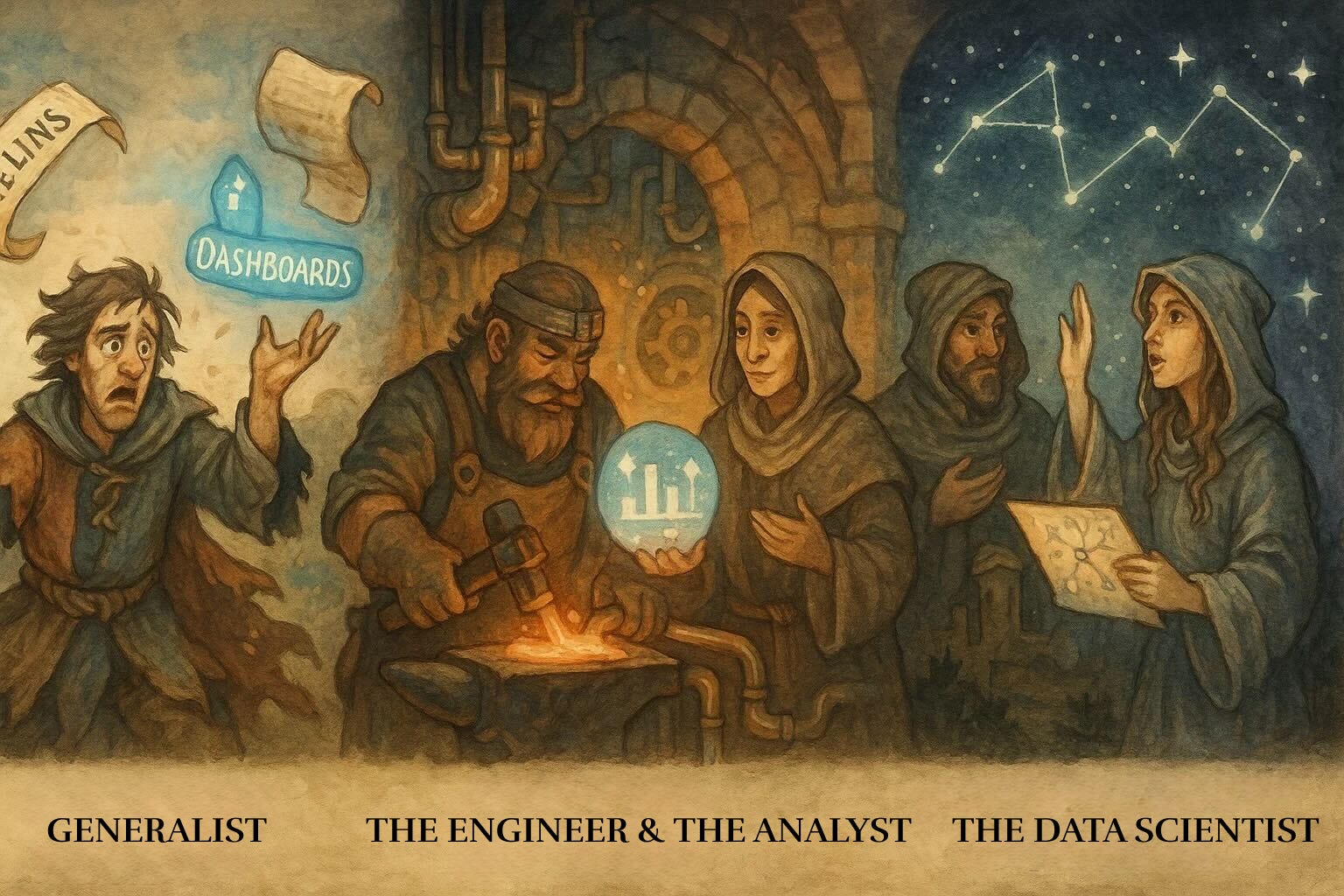
Of course, generalists don’t scale forever. Eventually, the gaps start to show. Pipelines break too often, reporting demands outpace one person’s bandwidth, or leadership wants to move beyond descriptive metrics into predictive insights.
That’s the moment to layer in specialists:
Engineer → when you’re juggling multiple sources and need real monitoring.
Analyst → when reporting grows into a full-time job and business context matters.
Data Scientist → once your data is trusted and you’re ready for churn models, forecasting, and segmentation.
Notice the order: infrastructure first, reporting second, prediction last. The sequence matters more than the job titles.
A scrappy hack that works better
If finding a unicorn generalist feels impossible, there’s a practical workaround: hire part-time talent to cover both ends.
For example:
A contractor engineer to keep the pipelines alive.
A part-time analyst to own reporting and KPIs.
Together, they cover 80% of what you need — without waiting six months for a mythical one-person solution. As the stack (and the budget) grow, you can scale those roles into dedicated full-time hires.
It’s not glamorous, but it works.
How I frame it to founders
When I sit down with founders, I don’t lead with job titles. I start with their pain point.
If their biggest headache is “we don’t know what our sales funnel looks like” → that’s an analyst hire.
If it’s “our pipelines keep breaking and no one trusts the numbers” → that’s an engineer.
If it’s “we need a strategy for what data even matters” → that’s where a Fractional CDO comes in.
The label matters less than closing the actual business gap.
Weekly Roundup
Every week, I share standout posts that challenge how we think about building data teams — and who we trust to do the work.
This week’s picks all circle around the same tension we unpacked today: companies chase unicorns, overload their hires, and end up with burnout instead of progress.
Here’s what caught my eye:
1. “Engineers turned firefighters.”
[Read the post →]
Christian nails a subtle trap: when every day is spent patching pipelines and fixing broken dashboards, your data team stops building. You don’t scale infrastructure, you just scale firefighting.
It’s a vivid reminder of why hiring a specialist too early often backfires. Without stable foundations, even the best engineer will be stuck reacting instead of building.
2. “That’s not one role. That’s four.”
[Read the post →]
Arthur shared a job post asking for someone to build pipelines, run ML, do analysis, and make dashboards. Sound familiar? It’s the unicorn fantasy in disguise.
His breakdown — analyst, engineer, scientist, analytics engineer — shows why mashing these hats together is a recipe for 3-month burnout. It connects directly to today’s point: you’re better off covering bases with scrappy generalists or part-timers than pretending one hire can do it all.
3. “Expectation vs reality for grads.”
[Read the post →]
John’s post is short but brutal: data science grads expect to predict the future. Instead, they’re stuck explaining why two dashboards disagree.
It’s funny because it’s true — and because it underscores why a data scientist is the last hire you should make. Until the basics are working and trust is in place, you’re just setting them up for disappointment.
Takeaway:
Whether it’s firefighting, role-mashing, or mismatched expectations, the pattern is clear: most hiring mistakes come from trying to skip steps. Get the foundations right, hire for today’s problems, and leave the unicorns to fairy tales.
That’s it for this week
Early-stage teams waste too much time hunting unicorns.
The smarter move is to hire people — or combinations of people — who solve today’s problems, not tomorrow’s fantasies.
Early data hires don’t need to be unicorns — they need to be the right humans for the problems in front of you.
Until next time —
Nick from Valiotti Analytics