
You Don’t Need to Scale a Team to Scale Your Impact
Vol. 20: The Systems > People Edition


Welcome back to The Datapreneur — the newsletter where we strip away the corporate theater, get real about what works, and build data teams that don’t burn cash chasing myths.
This week, let’s talk about another common illusion in growing data teams:
the idea that scaling impact means scaling headcount.
Every founder has been there.
Revenue’s up. The backlog is long. The Slack channels are buzzing.
And the reflex kicks in:
“We’re growing — we need to hire.”
It feels responsible. Strategic. Like you’re building capacity.
But here’s the uncomfortable truth:
scaling headcount isn’t the same as scaling impact.
In fact, for most companies, it does the opposite.
TL;DR
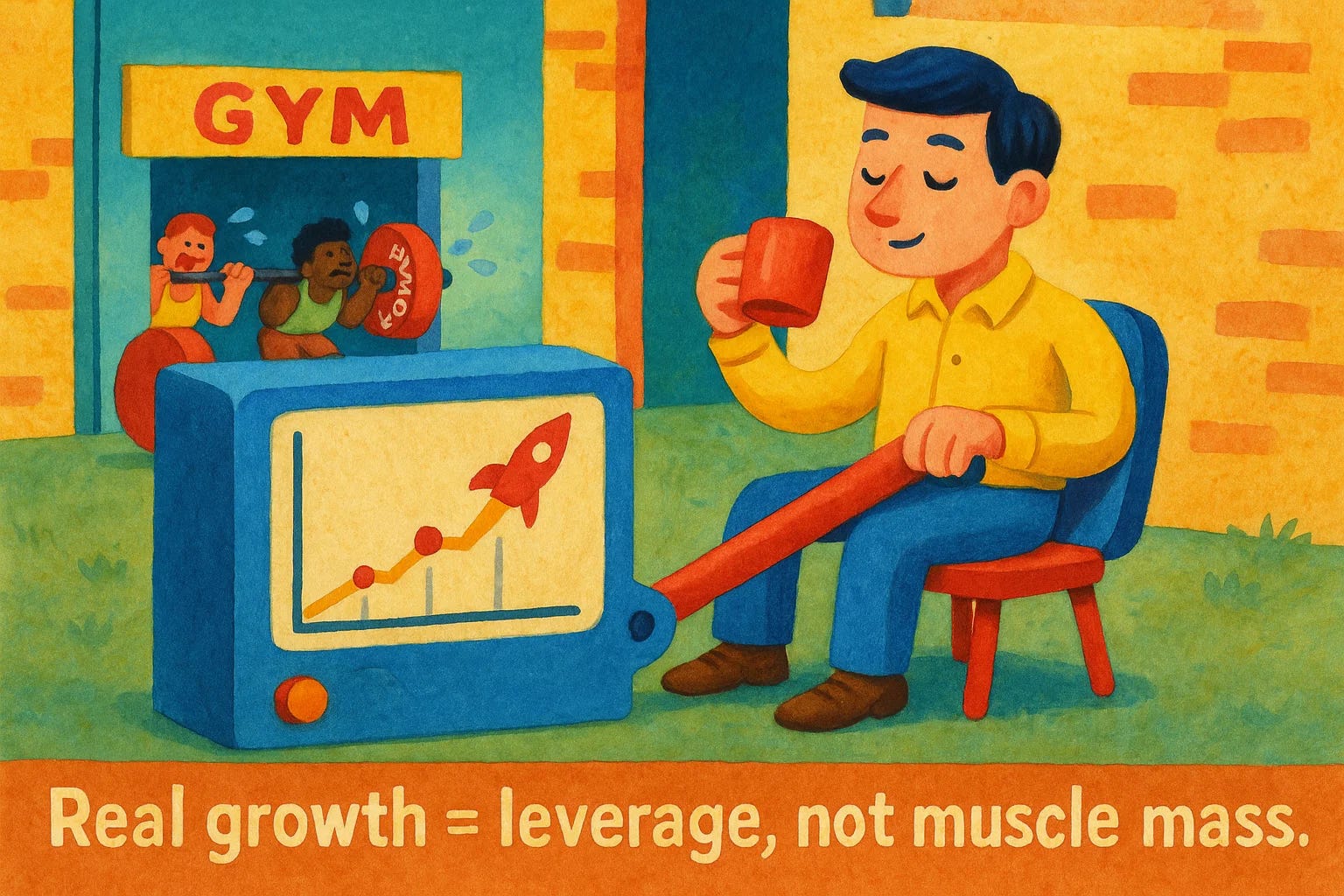
Growth isn’t about headcount — it’s about leverage.
The best teams don’t add people to move faster.
They design systems that make the people they already have more effective.
Focus on:
clear ownership and repeatable processes,
automation that eliminates manual chaos, and
external partners who can scale your capacity on demand.
Build a system, not a staff list.
Growth ≠ Headcount
Hiring always feels like progress.
It creates motion — interviews, onboarding, new job titles, new tools.
But motion isn’t the same as momentum.
Behind the scenes, that motion often hides a deeper issue: the absence of structure.
Without clear processes, documentation, and ownership, every new hire adds:
another layer of communication,
another point of dependency,
another version of the truth.
Suddenly your “growth” looks like this:
more meetings, more dashboards, more confusion.
You spend half the week syncing instead of solving, defending numbers instead of using them, and firefighting instead of building.
What you’ve scaled isn’t output — it’s noise. And once you start scaling noise, it becomes very hard to tell what progress even means anymore.
The leverage shift
The best data setups I’ve seen weren’t the biggest ones.
They were the clearest.
One analyst. One engineer. One strategist.
Three people who built the analytics backbone for a company that scaled to $1M MRR — without adding a single full-time role.
Their secret wasn’t talent. It wasn’t even speed.
It was leverage.
They automated pipelines that used to take days.
They cleaned their warehouse once and stopped touching it every morning.
They defined ownership so precisely that decisions made themselves.
When your foundation works, you stop firefighting and start thinking.
And when people can think — instead of constantly fixing — output compounds.
That’s leverage, that’s what scale actually feels like.
The new model: small core, scalable network
The smartest companies today aren’t hiring endlessly.
They’re designing for elasticity.
A modern, high-leverage data setup doesn’t look like a pyramid.
It looks like a hub — a small, focused core surrounded by flexible capacity.
At the center:
a Fractional CDO who sets direction and alignment,
one engineer who builds and maintains the infrastructure,
one analyst who understands the business and translates data into decisions.
Around them:
a trusted external team that can extend capacity when it’s needed — and disappear when it’s not.
That’s the balance: lean but limitless.
Your internal team owns the why.
Your external partners handle the how.
And your systems make the two indistinguishable.
When built right, that setup can outperform a 15-person department — not because it’s faster, but because it wastes nothing.
This is exactly where teams like ours in Valiotti Analytics come in.
Our Marketing Analytics in 90 Days program helps companies like yours go from scattered data to a unified, insight-driven foundation — without hiring a single full-time role.
In three months, you get a clean data stack, automated reporting, and a clear measurement framework that actually drives growth.
Why it matters
Every extra hire adds complexity.
Every unclear process adds friction.
Every disjointed tool adds latency.
Multiply that by ten, and you’re not scaling insight — you’re scaling drag.
But when your architecture is clean, something different happens.
Automation amplifies effort.
Clarity compounds output.
Small teams start to punch way above their weight.
That’s why I always tell founders to pause before hiring and ask a single question:
“Is this a people problem — or a system problem in disguise?”
Nine times out of ten, it’s the latter.
The takeaway
You don’t need to scale a team to scale your impact.
You need to scale your leverage.
Because headcount is an expense.
Leverage is a multiplier.
Build systems your people can rely on.
Document ownership so knowledge doesn’t get lost in handoffs.
Automate what doesn’t need a brain.
And when it’s time to grow, extend outward — not upward.
That’s how modern data teams scale:
less headcount, more clarity, faster results.
Weekly Roundup
Every week, I share standout posts that challenge how we think about scaling data teams — and how to do more with less.
This week’s picks all circle around the same theme as today’s issue:
impact doesn’t come from hiring faster — it comes from building smarter.
Here’s what caught my eye:
1. “Data is a cost. Knowledge is an asset.” — Clare Kitching
[Read the post →]
Clare nails one of the quiet truths of scaling:
collecting data isn’t leverage — using it is.
She lays out how real leadership isn’t about building dashboards or warehouses; it’s about building translators — people and systems that turn data into decisions.
If your analytics team keeps expanding but your decisions don’t speed up, this one will hit home.
2. “Everyone’s hyped when it’s time to talk tools.” — Sebastian Hewing
[Read the post →]
Kat captures the other side of the illusion: teams obsess over tools but skip the “why.”
They hire fast, buy fast, and still stall — because no tool can replace strategic focus.
It ties perfectly into this week’s message:
you don’t scale impact by adding stack — you scale it by understanding the problem.
3. “Ask for help BEFORE your superiors do.” — Shachar Meir
[Read the post →]
Christian’s post is a dose of honesty for data leaders: sometimes, scaling impact means asking for help.
You can’t build strategy, infrastructure, and culture alone.
Bringing in external perspective isn’t weakness — it’s leverage.
(And that’s exactly why smart companies lean on fractional teams instead of rushing to hire full-time.)
That’s it for this week
If your company is growing but your impact isn’t — you might not need more hires. You might just need a better system.
Until next time —
Nick from Valiotti Analytics